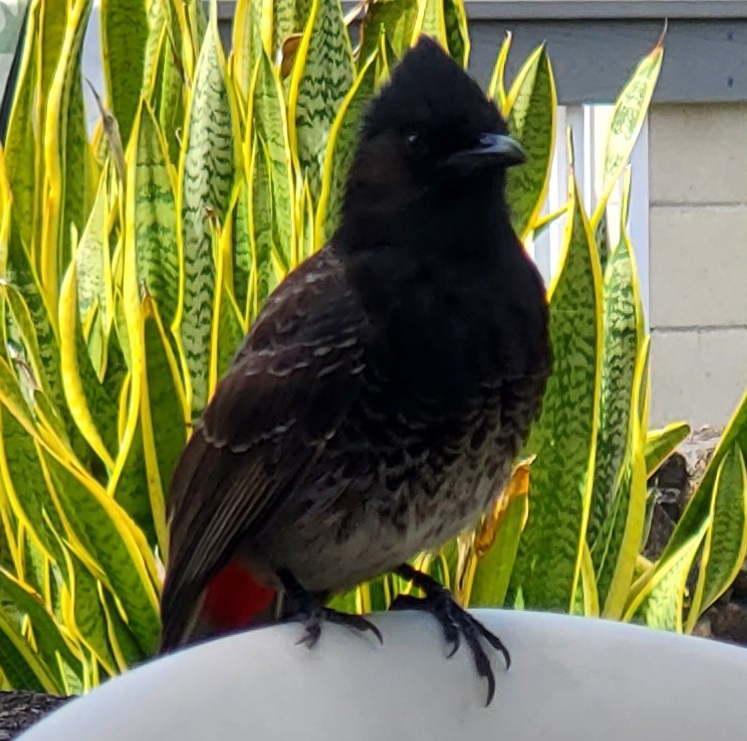
If I could wing into any affair as boldly as you, perch on a chair all clever black crown and silvery flare, with barely a flash of scarlet down there, I would be welcome anywhere.

If I could wing into any affair as boldly as you, perch on a chair all clever black crown and silvery flare, with barely a flash of scarlet down there, I would be welcome anywhere.

If the quantum wave function is the engine of time, relentlessly transforming probabilities into unique outcomes, is there a role for free will in that relentless transformation?
It may be that the interaction between the wave function and the disentangled, post-Big Bang macrocosm serves as the engine of time, providing the physical framework for the recurring transformation of probabilities into outcomes that comprises macrocosmic history. Is what we call “free will” an instantiation of this universal mechanism for creating outcomes from probabilities, a localized expression of a generalized universal process for creating the future?
The neuroscientist Anil Seth talks about free will in terms of “degrees of freedom.”[1] In other words, humans have the ability to make voluntary choices, given the range of options available to us, but our choices are not unconstrained. There are obvious and practical limits on the freedom of action of any human being or any conscious entity whether human or not. None of us, for instance, is free to violate the laws of physics.
And yet we have some degree of freedom. We make decisions. We choose within the constraints given to us. Our choices may be circumscribed, but they are not predetermined in every respect by what has come before.
There was a time when scientists believed that every action in the universe could be predicted by previous events. With sufficient information about all the forces exercising influence over the current moment, we could predict all subsequent moments just as the movement of billiard balls can be predicted based on their positions and the forces applied.
That version of scientific determinism died with quantum mechanics and the uncertainty principle. Today we know that we live in a world of probabilities, not certainties. There is no absolutely predetermined path for all objects, waves, or even time. There is only the quantum wave function and its ability to describe probabilities with astonishing accuracy.
The wave function is an arrangement of probabilities, not a prediction of one specific outcome for every interaction. However, it is accurate across a large number of interactions, and the future wave function of a system is determined by the wave function of that system in the present, i.e., the probabilities of the future are determined by the probabilities of the present.[2] Some would say that quantum mechanics in that sense is every bit as deterministic as Newtonian physics.
But it is also true that the wave function of any future moment is influenced by the outcomes arising from the wave functions of prior moments. Every set of probabilities yields an outcome, which then influences the wave function for the next moment, creating a new set of probabilities and a new outcome. The process repeats over and over and over again.
Even a deterministic wave function provides degrees of freedom to influence each successive outcome. The wave function limits my personal freedom in a way that is conceptually similar to something very mundane—the constraints of everyday life. We make decisions within those constraints, i.e., within the range of probabilities provided by the wave function. Those constraints and probabilities set a context and circumscribe our choices. Is that “free will?” Do we need more than that?
There is a plausible version of reality in which the universe is governed by the mechanics of the wave function. Time itself is driven by the many ways in which the universe transforms probabilities into unique outcomes.
We as humans do not control either the macrocosmic or microcosmic mechanism that drives that process. But we are part of it. We are at the very least cogs in the mechanics of time and the wave function.
What we call “free will” may be one of many mechanisms in the universe contributing to the mechanics of time. We make decisions and exercise choices. Our choices in each moment affect the probabilities that define the range of options in the next moment. Every moment of our existence, every nanosecond, proceeds in this way.
That is what we do. What the universe expects us to do. What the mechanics of time and the wave function demands that we do. We help resolve probabilities into unique outcomes by exercising the degrees of freedom offered by the complexity of our brains and our everchanging, illusory sense of self. That is who we are.
If the engine of time relies on the continuing interactions which transform probabilities into unique outcomes, we may have an essential purpose in helping to drive those transformations within our small sphere of influence. It is entirely possible that time and history depend on entities like us fulfilling that role.
We do not have the freedom to violate the laws of physics, but the laws of physics themselves may determine that we exercise the degrees of freedom available to us. Just as other entities in the universe must exercise the degrees of freedom available to them in order to drive the engine of time.
If the quantum wave function is the engine of time, the function of that engine requires mechanisms for transforming probabilities into unique outcomes. It requires disentangled interaction to influence and drive the progress of time.
What we call “free will,” governed by the constraints of our circumstances and the laws of nature, may be one of those mechanisms of disentangled interaction. The process of exercising free will may be functionally equivalent to the process by which a quantum wave function resolves into a unique outcome.
In other words, we have exactly the freedom that the universe gives us. We have the ability to transform a range of probabilities into unique outcomes. That is a powerful ability. And it is given to us by the fundamental forces of nature. It is what the universe does. It is what we do as part of the universe.
[1] “[E]ach of us has a very real capacity to execute and to inhibit voluntary action, thanks to our brain’s ability to control our many degrees of freedom…. It is not, however, freedom from the laws of nature or from the causal fabric of the universe.” Seth (2021), p. 230.
[2] Some might say even that the outcome itself is deterministic within the particular universe in which we exist. That all outcomes are determined within at least one of the many universes that spring into existence at every quantum intersection. But that begs the question—what determines which of the many universes will comprise the unique one in which each of us lives? It is certainly not the bouncing of the billiard balls, or why would there be a need for any universe but one.
Physicists say that entropy sets the direction of time. A broken teacup falls apart; it does not spring back together. Heat spreads and dissipates; it does not increase without a source of new heat. Unless the second law of thermodynamics is false, aggregate entropy in the universe can only increase, not decrease. Entropy advances inexorably—the force that points the arrow of time toward the future.
All things in spacetime therefore move only in one direction ultimately. That has been true since at least the Big Bang, the immediate result of which was a universe of very low entropy. Exploding from perhaps a microscopic singularity, the universe became almost instantaneously a massive macrocosm of ordered, compressed, very hot energy. That macrocosm has been expanding and expending that energy since, and there was ever only one direction for it to go—toward a state of lower heat and higher entropy.
My question is different from the one answered by entropy. I want to know not why time goes in one direction, but simply why time goes.
When you wind a pendulum clock, there is only one direction for the springs to go. They unwind; they do not wind up if left alone. They do not move if left alone, unless and until the pendulum moves. What swings the pendulum? What starts the clock?
If the universe could go in only one direction after the Big Bang, why did it go? Why didn’t the universe stand still without moving forward or backward? Why did the universe go in any direction?
A physicist might say that the universe is a place of constant quantum activity, with so much inherent quantum evolution of systems or general quantum fluctuation that it is impossible for the universe ever to stand still. The universe must go; the quantum state of the universe demands it.
But the microcosmic quantum world may not follow the arrow of time or depend on entropy in the way prescribed in the macrocosmic world. A quantum wave function describes the probability amplitudes of different possibilities, all of which can remain in a state of superposition in the microcosm. Schrödinger’s cat can be both dead and alive. Without a single, unique state, it has no definite history of unique moments following one after the other. Instead, the cat exists in a state of constant possibility evolving into more possibilities.
It is not until the cat interacts with the macroscopic world that its fate is known—or that it has any fate at all. Without the macrocosm, the quantum world is little more than a soup of constant interaction and simultaneous possibility. And that quantum soup does not have a direct relationship with time or forward direction. At the quantum level there very likely is no time and no direction in time; there is only the quantum wave function.
The quantum microcosm underlies the grand sweep of history, but it is not history. History requires more than a quantum puzzle of entangled superpositions; it requires change and movement, actual unique events, a macrocosmic world evolving over billions of years. History and time assume a quantum wave function that results in more than superpositions with constantly changing probability amplitudes, but instead produces a stream of unique macrocosmic outcomes, a stream of history.
Probability is a function of time, measuring the likelihood of change and movement. At its core the quantum wave function is a probability distribution that both calculates abstract possibilities in superposition and measures the likelihood of detecting an actual event[1] in a particular location and time. It effectively assumes the existence of time as a medium in which probabilities have the potential to resolve into outcomes.[2]
The quantum wave function exists in two phases. In the first phase, when a system is isolated, the wave function exists as superpositioned probability amplitudes evolving according to the deterministic rules of the Schrödinger equation. In the second phase, when a system is not isolated, when the wave function interacts with something distinct from itself—something in the macroscopic world—it evolves in a new and more random way. Instead of a microcosmic wave function of probability amplitudes, it becomes a set of actual probabilities that resolve into one unique outcome in the macrocosm. Essentially, the dice are thrown, resulting in a unique moment in time and history.[3]
We don’t know why or how interaction with the macroscopic world causes probability amplitudes to resolve into outcomes. We don’t know if quantum wave functions “collapse” to produce unique outcomes or if the universe splits into “many worlds” at every quantum intersection. We know only that the universe includes some form of interaction between the macrocosmic and quantum worlds that results in probabilities becoming outcomes—that produces a stream of outcomes.
Quantum wave functions as we know them interact with the macrocosm and resolve calculable sets of probabilities into unique outcomes. Each outcome influences another wave function and another set of probabilities, which resolves again into a new unique outcome. That is how the macrocosm functions today. That is how history progresses. That is how time works.
Perhaps before the Big Bang there was only quantum fluctuation or isolated quantum evolution, with no history and no time. A world of possibilities and probabilities only, without direction, without outcomes, without resolution. There was no spacetime and no macrocosmic world, perhaps only a universal state of complete, unbroken entanglement.
In such a pre-Big Bang universe, there could have been no possible interaction between a macrocosmic world and the microcosmic quantum world. There was only one thoroughly entangled universe with no interactive mechanism for possibilities to become outcomes. Wave functions that interact with a macrocosm, driving the universe forward, resolving probabilities into outcomes—did not exist at all.
Yet that timeless quantum world eventually fluctuated into an explosive state that produced the Big Bang. The result was a macrocosmic world of massive, organized energy with very low entropy, a disentangled universe waiting for a new form of quantum interaction.
If interaction with the macroscopic world causes quantum wave functions to resolve into outcomes, did the state of low entropy that followed the Big Bang set the stage for that macroscopic interaction? Did the Big Bang create just enough separation and disentanglement in the universe to start the chain of collapses and unique outcomes that we know as history? Just enough of whatever it took to cause quantum wave functions to resolve into unique events, pushing all other possible outcomes into the realm of imagination or many worlds? Is the wave function the engine of time?
It may be reasonable to think of microcosmic quantum reality as a world of possibilities only—a world where all things are possible, a world that mathematically defines the probabilities of all outcomes. But a world without a mechanism for turning probabilities into outcomes.
It is the macrocosmic world that is about outcomes. The great illusion that is the macrocosmic world may be the mechanism by which the universe creates outcomes. Perhaps when quantum fluctuation caused the Big Bang and created spacetime, that new macrocosm became a Petri dish for a new form of quantum interaction that enabled probabilities to resolve into outcomes, starting the clock of history and birthing the great illusion that we live in today.

[1] Which may or may not be equivalent to the likelihood of an event occurring in a particular location and time.
[2] A probability and outcome assume movement and change. Something is probable and then something occurs. Does the concept of probability have meaning without the possibility of a future outcome? Perhaps. But is difficult to conceive of a world of probability that would not eventually, in some way, experience an outcome.
[3] Roger Penrose has suggested that this result, called quantum state-vector reduction, could be explained as a gravitational phenomenon in a yet-to-be-specified theory of quantum gravity. “My own point of view is that as soon as a ‘significant’ amount of space-time curvature is introduced, the rules of quantum linear superposition must fail. It is here that the complex-amplitude superpositions of potentially alternative states become replaced by probability-weighted actual alternatives—and one of the alternatives indeed actually takes place.” Penrose (1989), p. 475 (emphasis in original).
Beneath the surface of the great illusion, the universe is seemingly a soup of quantum interaction generating a constant flow of illusory experience on the four-dimensional stage of spacetime. We and all other entities in the universe play out our existence as part of this great drama.
For most of our recent existence, we humans have imagined that the great drama is mostly about us. We see ourselves at the center of the universe, brought into existence by a creator who stages the play for our benefit.
We know now that we are not the center. The sun does not orbit around us as we once thought. Our sun’s system is one of hundreds of millions in the Milky Way galaxy, which is one of hundreds of millions of galaxies in the universe. The likelihood that this great expanse exists for our sake seems vanishingly remote.
So if the universe does not exist for our sake, do we at least have a role in the great drama? Absolutely.
We even have an important role, one that we share with all other entities alongside us in the universe.
We make choices. We make decisions. We act and interact. And by doing so, we turn probabilities into reality.
The universe presents us with options every moment of our existence, and from those options we make choices. Every choice transforms a host of probable possibilities into a single outcome. Sometimes we choose the most probable outcome; sometimes we do not. But every choice, action, or moment of awareness adds a unique outcome to the stream of outcomes that shape the drama of the universe.
We live in uncertainty, both in the macrocosmic world of the great illusion and the microcosmic world of quantum reality. It is not a practical uncertainty, driven by unknowns, but a fundamental uncertainty driven by quantum interaction. The core of our reality is not an endless stream of cause and effect pushing the universe down a wholly determined path. Our universe is about a flow of probabilities and interactions, with every interaction affecting the next set of probabilities. The future can never be predicted definitively in the way we once imagined; it is possible only to know the probabilities for the future. That is fundamental, and it cannot be changed.
Every choice and every experience eliminates other potential options from contention. By choosing among the options and experiencing each moment presented to us, we create information about the universe.[1] Constantly. That is what we do.
Not just us. Every creature or organism that moves or acts or chooses or experiences, even in a rudimentary way—turns left instead of right, flies or walks, jumps or dives, slithers or stays at rest—creates information about the world. Every one of those actions or experiences define what the world is instead of what it could have been.
A philosophizing physicist might suggest that we and other entities help collapse the quantum wave function of the universe. That perhaps every choice or experience collapses the wave function of probabilities for that moment into a single outcome. And that every outcome then affects the distribution of probabilities in the wave function for the next moment.[2]
Like all the other creatures or entities that inhabit the universe, we help transform the universe from probability to reality. We create information about the universe that turns the future into the present. That is our role. The universe needs us to do that.
So we are in the play and the cast. Our role is vital. But it is not unique to us.
[1] “At any one time, we have precisely one conscious experience out of vastly many possible conscious experiences. Every conscious experience therefore delivers a massive reduction of uncertainty, since this experience is being had, and not that experience, or that experience, and so on. And reduction of uncertainty is—mathematically—what is meant by ‘information’” Seth (2021), p. 56.
[2] A set of probabilities prior to an interaction results in an outcome from the interaction. That outcome then changes the state reflected in the wave function for the very next moment. The world is presented with a new wave function, a new set of probabilities that influences a new interaction and outcome. And the process repeats itself. On and on. Forever. This is how quantum mechanics might describe creating the future.
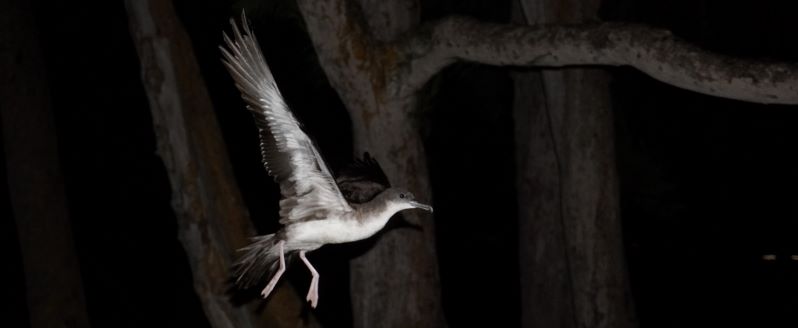
Pity the wedge-tailed shearwater, moaning in the dark daily, rising unfailingly from beneath the sands to vanish in shadows between the pink-orange sky and the blue-black sea.

Spacetime is the stage where the great illusion unfolds. It is the fabric of the macrocosmic universe, the matrix underlying the holodeck.
But how real is it?
Certainly it is real in the sense of scientifically verifiable. Experiments confirm how space and time interact in the four-dimensional spacetime field. The empirical reality of spacetime is not subject to reasonable doubt.
So is spacetime the underlying reality beneath the great macrocosmic illusion? Is it fundamental? Is it real in that sense?
Probably not.
Physics says that spacetime began early in the history of the universe and that without the Big Bang spacetime might not exist.
We don’t know what, if anything, was before spacetime; we don’t know what, if anything, could follow spacetime. Before the Big Bang the entire universe could have been subsumed in a singularity without time or spatial dimension. There could have been nothing at all, just a vacuum of “nothingness” with random quantum fluctuations.[1]
The future of the universe also could be a singularity. Or perhaps with all free energy spent and entropy at its maximum, there could be nothing remaining but the seeming stillness of quantum interactions in a state of universal thermodynamic equilibrium.
Whatever the universe was, or will be, there is something more fundamental than spacetime. Spacetime began.
We think of the universe as spacetime and a collection of galaxies and stars and planets, comprised of microscopic particles and fundamental forces that shape all things and events. But is the universe composed of core components at all? Or is what we conceive as the underlying microscopic reality of the universe also an illusion? Is there something more fundamental than either the macroscopic world of galaxies and stars or the microscopic world of electrons and atoms?
We know that the objects that curve and bend spacetime are not themselves solid as they appear. They have massive gravitational fields but are little more than empty space containing orbiting or vibrating wave-like semi-particles held together by forces more fundamental than their own gravitational mass. The tiniest semi-particles in the universe are knots of energy interacting in patterns constantly, and every physical “thing” is at its deepest level a process or interaction. Beneath the hood reality is not a collection of irreducible substances, but interactions and processes and events that give rise to the illusion of substances.[2]
We know that time is not absolute and unchanging, that the processes, events, and interactions that drive the universe are not arranged in lockstep chronological order. At the most fundamental level of known reality, the arrow of time does not drive a chronological history of distinct events. Instead, at the quantum level, there are no distinct events, but only a stream of wave functions describing the probability amplitudes of an almost infinite spectrum of possibilities. Instead of driving events, entropy and the Second Law of Thermodynamics may only influence the shape of those microcosmic wave functions. It is only above the level of the microcosm, in the great illusion of the macrocosmic universe, that wave function amplitudes become actual probabilities resolving into unique outcomes and the distinct events of history.
Is the microcosmic core of the universe nothing more than a timeless lake of entangled possibilities arranged in order of probability by the physical laws of the quantum wave function? Or beneath even that, is it a vacuum of nothingness comprised only of random bursts of quantum fluctuation? Is this the underlying reality from which the great illusion has sprung in some way that we do not understand?
The great illusion may not be the macrocosmic universe as we know it, the world of countless galaxies with trillions of stars and planets, the world of mountains and oceans. Perhaps the ultimate illusion is the world of spacetime itself and the laws of physics that govern the interactions of what we perceive as objects in spacetime. Entropy and the laws of physics and the reality of local time and relative time may not underlie the illusion; they may be the illusion, the very things that comprise the holodeck and our reality.
Beneath it all may be only the quantum wave function itself—ceaseless interactions, entanglements, and superpositioned possibilities—somehow resolving into a stage where all probabilities play out. Perhaps everything else is imagined and illusory, a way of talking about reality, but no more real than mountains and oceans and waves crashing on the shore.[3]
So no, spacetime is probably not real in the sense of the fundamental basis of the universe. It is a constructed stage. Constructed out of the many possibilities inherent in the quantum universe—for us and all other things and entities that exist in the universe. It is our stage, but it is not the bottom of what is real.
[1] Keen (2013).
[2] “The world is not a collection of things, it is a collection of events.” Rovelli (2017), p. 98.
[3] “Not only does the deepest layer of reality not consist of things like “oceans” and “mountains”; it doesn’t even consist of things like “electrons” and “photons.” It’s just the quantum wave function. Everything else is a convenient way of talking.” Carroll (2017), p. 171.
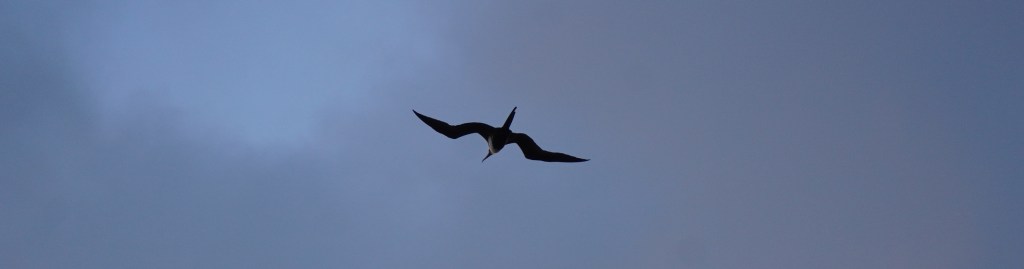
Up before dawn to lie in wait for the frigatebirds, soaring the windward coast, east to Moku Nui at rise.

Life is process, process is change, and time measures change. Time enables life to occur.
Aristotle conceptualized time as the measure of change more than two thousand years ago. He theorized that the experience of time requires change, therefore without change there could be no time. Aristotle’s theory was a philosophical precursor to what Einstein later recognized as spacetime.
Einstein discovered that time is not merely the measure of change; it is inextricably intertwined with space in a four-dimensional field that serves as the underlying matrix for all movement and change in the macrocosmic universe.
Change assumes movement of some kind, movement assumes space in which to move. In spacetime, time becomes the measure not only of change, but of space itself.
Space and time are different aspects of the unified field that is spacetime. One cannot exist without the other. Time exists because existence in space and movement in space create time. Without existence or space in which to exist, there could be no time.
Spacetime spans the macrocosmic universe. It curves and rolls around concentrations of matter, bending in response to the gravitational forces of planets, stars, and galaxies. Light traveling across the universe rides those curves, bending and rolling according to the bends and rolls of spacetime.
Where spacetime curves around large concentrations of matter, time slows as though space becomes dense and thick. If an object travels through spacetime at great velocity, time for that object slows. Time and space exist in something like a zero-sum bond, with the velocity of travel through one increasing only at the other’s expense. The faster you move through space, the slower you move through time.
Physicists like to say that the Big Bang created spacetime. In the immediate aftermath of the Big Bang the universe was a place of extremely high pent-up or ordered energy[1] and consequently very low entropy. The universe has been expanding rapidly ever since, transforming that reserve of free energy into disordered random heat and steadily increasing the entropy of the universe.
Physicists also say that the unrelenting increase of entropy is what sets the direction of time. Time does not flow backward because total entropy in the universe cannot decrease.[2] A basic law of physics—the Second Law of Thermodynamics—pushes entropy to increase, with time, until the universe reaches some unimaginable state of thermodynamic equilibrium far in the distant future.
The Big Bang created the space in which both change can occur and time can exist. It was necessary for both to exist together because neither could exist alone.
Spacetime became the fabric of the macrocosmic universe. It is the physical and temporal location where the laws of physics play out and the great illusion of the macrocosmic universe unfolds.
If all the world’s a stage, then spacetime is that stage.[3]

[1] Also described as free energy available to do work in the universe.
[2] Does time also require an engine in addition to a direction? If time cannot go backward because total entropy in the universe cannot decrease, is there anything that makes time go forward? What makes time go at all?
[3] For one of many similar analogies, see Siegel (2017). “The Universe is a play, unfolding every time a particle interacts with another, and spacetime is the stage on which it all takes place.” https://www.forbes.com/sites/startswithabang/2017/01/28/ask-ethan-what-is-spacetime/?sh=71ce688350bd
The universe is vast, and we are small. If we vanished tomorrow, the universe would go on much as before. If our solar system vanished, or the entire Milky Way galaxy, the result would be the same. Against the backdrop of the universe, our existence seems insignificant to say the least. And if the macrocosmic universe itself is an illusion, is that not final proof of our ultimate insignificance in the great scheme of things?
And yet four centuries after Galileo, we still imagine ourselves at the center of all things. We insist that we have a role to play on even the greatest stage. But do humans really have such a purpose? Are our tiny lives important to the universe? Or is it arrogance alone that makes us think so highly of ourselves?
In all likelihood we are exactly that insignificant. But before we accept the obvious answer, perhaps we should examine what we know.
First, we are a legitimate part of the universe. We have no reason to assume that we are less legitimate than other elements of this vast all. If our part of the universe is insignificant, we likely must conclude that other parts of the universe are just as insignificant. We might have to ask whether the universe itself has any discernible significance.
Alternatively, if we assume that all elements of the universe have some significance—for no other reason than each element plays a role in the functioning of the whole—then we must conclude that our existence also has at least that much significance. We play some role. We are not accidental to the mechanism of the universe, but rather part of the functioning of that mechanism. Even the illusion of self may have some minor part to play in the illusion that is the whole macrocosmic universe.
Second, as far as we know, we and other conscious entities are the consciousness of the universe. And since our knowledge of conscious entities is limited, it is conceivable, if unlikely, that we ourselves are a primary source of consciousness in the universe. Even if we are not alone, we are a means for the universe to experience conscious existence.
To state the obvious, that experience includes the basics such as observation, awareness, and intentionality, but also more intangible things such as language, imagination, creativity, literature, philosophy, science, civilization, not to mention friendship, love, loss, and even death.
What if the universe can know itself and all these things only through us and other conscious entities? Is that our role? Does that give our existence meaning and importance?
Third, what if in addition to knowing itself through us, the universe also finds purpose through us? Not because we are its purpose, but because we search for purpose. In other words, through us the universe experiences a search for purpose.
We need not assume that we are the reason for the universe or that the universe was created for our sake. We can accept what seems obvious from the tiny scope of our existence, i.e., that we are not the most important part of the universe. But we are a part of it. And we happen to be a part that looks for purpose, both our own and the purpose of the universe itself.
Could our seemingly insignificant lives help the universe find its purpose? Does the universe even have or want a purpose?
Again, all we know for sure is that the universe has conscious entities within it that search for purpose and meaning. Just as the universe experiences consciousness through its components with consciousness, the universe may experience meaning through its conscious components that search for meaning.
Is that enough? Can the universe rely on conscious components to find meaning and thereby create the universe’s own meaning?
We often imagine that the underlying meaning and purpose of reality is discoverable, something known out there that we cannot see. We spend lifetimes studying the universe or meditating to uncover its secrets. But could it be true that the universe has only what we give it, that it has the meaning that conscious entities within it search for and create?
The universe may or may not have a purpose, but it has a search for purpose. It has us.

If we are as we seem to be—organic mechanisms with consciousness—how did we come to be? Why did the universe generate life forms such as us? Was it an accident? Is consciousness an accident?
There are two central questions here. First, how did life come to be? Was it an accident of chemistry or were there forces in the mechanism of the universe that caused it to generate life? Second, once life came to be, how did consciousness also come to be? Why did we with our many questions come to exist? Why is the universe not populated by organisms with simpler brains and far fewer questions?
For the time being, I will leave the first and most difficult question to others.[1] It may be that the creation of life as we understand it was an accident of chemistry. For now I will say only that when the Big Bang created the diversity of matter and energy that came to form the macrocosmic universe, it perhaps was not surprising that such diversity included the raw materials of evolution, awareness, consciousness, and self-examination of the universe itself.
The second question is marginally easier to address than the first. It comes down to how and why natural selection generates beings with consciousness as we know it. Is consciousness an accidental artifact of evolution or is there a mechanism or principle that biases natural selection toward the evolution of consciousness?[2]
It may be true that consciousness, once it exists, is a trait that increases reproductive success. A gradual and incremental evolution of consciousness may be a natural result of the increasing survivability of species that develop efficacious systems for maintaining awareness of the outside world and the potential threats and opportunities that can be found there. That by itself may be sufficient to explain the existence of consciousness as a survival mechanism. But is it enough to explain conscious intellectual life as we know it? Or does some other characteristic or refinement of consciousness result in life forms that ask philosophical questions?
A rock does not care about its survival. It does not have “wants”. So we ordinarily do not think of a rock as having consciousness or a desire to ask philosophical questions. Nor do we think of a rock as being subject to natural selection.[3]
At a certain point in the development of the universe, however, organisms appear that are subject to natural selection. They live and die and pass on hereditary characteristics to successors. It may seem obvious, but simultaneously or at some subsequent point, organisms appear that not only live and die and exist, but also have a desire to exist—to eat, to mate, to create a future. They want to survive and not to die. That “want” is almost certainly a trait that evolution selects for success.
Admittedly, it may play only an indirect or minor role in evolutionary success. The simple desire not to die surely must be present in all surviving species with any sense of awareness, so it is likely neither a differentiator among species or organisms, nor a statistical predictor of reproductive success. However, it is perhaps a precondition to the success of species like ours. Does that precondition help explain not only rudimentary consciousness but also the development of intellectual life as we know it?
To have the desire to live and not to die, an organism needs a definite boundary between itself and the external world, including other organisms. It must have at least some nebulous sense of self or “I”—the thing that does not wish to die. It also needs some awareness of “death” as loss of that thing. The desire to live and not to die therefore bears within it some fundamental questions about existence:
These basic questions are germinated within the most basic desire of any living organism—the desire not to die—and they are the recognizable seeds of philosophy and intellectual life.
As other traits evolve to make an organism more successful, the seeds of expanded consciousness grow and develop along with the intellectual capacities of the organism. They accompany the evolution of bigger brains that enable the manipulation of tools and the environment. They are there when language is created, hovering in the back of the conscious mind, ready for expression in the culture that language enables.
Organisms use their big brains to survive and build better, and the process of survival itself encourages the introspection that drives intellectual development. The one simple desire—wanting not to die—puts life on a path toward expanded consciousness. Even if the will to live is not a differentiator among species, it is a necessary ingredient for natural selection, and it may open a door that cannot then be closed, leading inevitably to full consciousness, self-awareness, and intellectual self-examination. The will to live may or may not make us stronger, but it does make us more philosophical.
All in all, there may be a clear path from that first moment of wanting to full sentience and human consciousness. Natural selection may be a biological and philosophical exercise, a way for the universe to evolve its own understanding of itself.[4] If that is true, then the gradual evolution of consciousness is a natural and expected result. It is not an accident. It is grafted onto the roots of the origin of species.[5]
[1] Thomas Nagel in Mind and Cosmos frames both questions and offers a far-ranging discussion of the pros and cons of philosophical theories that purport to answer them. Nagel (2012).
[2] Or is this one of an infinite number of universes with all possibilities realized in at least one? Hmm…. I am with Thomas Nagel on this possibility. “Well, there is the hypothesis that this universe is not unique, but that all possible universes exist, and we find ourselves, not surprisingly, in one that contains life. But that is a cop-out, which dispenses with the attempt to explain anything.” Nagel (2012), p. 95, footnote 9.
[3] Although it may be worth considering whether there could be some inorganic equivalent of natural selection that guides the evolution of substances and particles and processes in a way that is comparable to how natural selection guides the evolution of living things?
[4] “Each of our lives is part of the lengthy process of the universe gradually waking up and becoming aware of itself.” Nagel (2012), p. 85. “We are a way for the cosmos to know itself.” Carl Sagan.
[5] For the perspective of a neuroscientist on the biological origins of consciousness, see Seth (2021), p. 281. “The totality of our perceptions and cognitions—the whole panorama of human experience and mental life—is sculpted by a deep-seated biological drive to stay alive. We perceive the world around us, and ourselves within it, with, through and because of our living bodies.” (Italics in original.)