There is a record kept

Physicists talk about conservation of information. It is a fundamental law of classical physics—information cannot be lost or destroyed. Stanford physicist Leonard Susskind calls it the zero-minus law because it comes before all other laws—before the first laws and even before the zeroth laws.[1]

It means that each moment in time includes information about the state of the universe in that moment and every moment leading up to that moment. The location and momentum of every microscopic particle in a system, together with the forces and fields interacting with those particles, comprise the complete specification of the system in that moment. From that complete information, it is possible to determine exactly the state of the system in the immediately prior moment. And with that information comes the information about the state of the system prior to that. The entire prior history of a system, including the universe, is time reversible from the information contained in any one moment.

The result is that information about every prior moment is never lost. It cannot be lost. It exists in the full specification of every subsequent moment and the operation of the laws of physics on the particles, forces, and fields interacting in the system.

Not just the “important” information, but all information

The information in that moment includes everything about the system that could possibly be known. It is not limited to information that we have the practical means of discovering or knowing, but includes all the information, whether we know it or not. Theoretically, the complete specification of the system includes information about every element of physical existence in the universe at that moment.[2] That means the state of every planet, star, and galaxy, every molecule, atom and subatomic particle, and every entity of any kind. That includes information about all of biological existence, every cell and neuron in the brain of every entity. Even our thoughts and desires, which at some level arise from our physical existence, are included in the record of that moment.[3]

Are the past and the future as real as the present?

Einstein believed in what is called a “block universe”. He believed that conservation of information and the principle of relativity demonstrate that the flow of time is an illusion created by our perceptions. In the reality beneath our perceptions, time is not absolute, and the past and the future are as real as the present. If that view is correct, then the record kept by the universe may reflect more than a trail of time-reversible moments; it may reveal a universe in which every moment lives forever, in which moments actually do not die. We may exist even after we seem to die, as do those who came before us, and those that come after. We all exist because all moments exist at once in the block universe.

Is the record kept forever?

Physicists debate what forever really means. Black holes exist throughout the universe, and nothing, not even light, escapes a black hole. Stephen Hawking posited the possibility of radiation escaping from the event horizon of black holes as they dissipate over time. But we do not know if the physical information in so-called “Hawking radiation” is time-reversible in any meaningful way. If not, then the information about any particle that falls into a black hole is not conserved, but lost forever.

There is also the possibility that the universe will end its existence in a state of maximum entropy or “heat death”, with all information seeped away in a great expanse of dissipated nothingness. If that is the future universe, then all memory of our existence may be lost in that final state of maximum entropy, without any possibility of time-reversible recreation of the moments leading up to that state. But physicists have also theorized that our universe is one in a cycle of universes, that our universe will not die in a state of information-free nothingness, but rather will evolve to an end-state which could serve as the foundation of a new universe. Information about our universe could influence the wave function of the next universe, which then could influence another, on and on.[4]

Is conservation of information only a hopeful dream?

It is a comforting thought to imagine that we and all our loved ones exist forever in a physically possible block universe. But is it wishful thinking? Do physicists theorize about information recovery simply as a form of consolation?[5] Do we imagine that the universe will remember us to feel better about the inevitable loss of all that we and other humans are? Will Shakespeare and all his creations—and everything ever thought or created by any human—cease to exist without any record whatsoever? We want to believe that the universe keeps a record of our existence that cannot be erased, that exists for all time.

But time may not be what Einstein believed it to be. Time may pass. And not come back.

The block universe requires one arrow in and one arrow out

Conservation of information is based on the premise that both the past and the future can be calculated from the present. There must be one arrow in from the past and one arrow out to the future.[6] But quantum mechanics tells us that the arrow in may not tell the full story of the past and the arrow out may be only one of many possible futures. Conservation of information may not be absolute.

The future is probabilistic, but random

Evolution of particles and waves in the subatomic quantum world is governed by the quantum wave function described in the Schrödinger equation. Continuous evolution under the Schrodinger equation is time symmetric, even time-reversible, meaning the equations can be solved backward or forward, predicting the future or describing the past. The wave function produces weighted amplitudes that predict with great accuracy the evolving probabilities of a range of outcomes in the future. But the Schrödinger equation predicts only probabilities; it cannot predict the specific outcome of any one event. Specific outcomes are governed by a second phase of the quantum wave function, called quantum state reduction, in which the continuous evolution of the wave function devolves or reduces into discontinuous evolution and the probabilities resolve themselves into specific unique occurrences in the macroscopic world. Effectively, the dice are thrown, and the range of probabilities described by the equation is replaced by a single outcome—a unique event in time. There is no way to know in advance what that unique event will be. The equations predict the likelihoods of different events, but the actual unique outcome in each instance is a random result that occurs somewhere within the range of probabilities.

That means there is more than one possible arrow out to the future. The block universe may be less settled (or blockish) than we once thought.

The unrealized possibilities of the past are not recoverable

Perhaps even more significantly, the arrow in from the past cannot be reconstructed in its complete form based on information about the present. After the second phase of the wave function results in a specific random outcome, it is not possible to determine the shape of the wave function that preceded it. The weighted amplitudes of the Schrödinger equation, as well as the probabilities predicted by those amplitudes, cannot be recalculated from the outcome of the quantum reduction process. We can observe the result of the process, but we can no longer calculate the range of probabilities that produced that result. One possibility occurs, and all others are forgotten.

An imperfect record

We are left with a situation in which the future is probabilistic in general, but unpredictable in a specific instance; the future always has an element of randomness. The past also cannot be recreated fully from the present. We can find the specific event that preceded the present moment and track the string of present moments that resulted from the evolution of the wave function, but we cannot recreate the range of possibilities and probabilities that generated that string of moments. The logical conclusion is that the future is never completely known, and the possibilities of the past are lost forever.

So yes, there is a record kept. But the record is incomplete and likely impermanent. Moments are created in time, and time may not be eternal. Even if it were, time records only moments that actually occur in the macrocosmic world. Time is not a record of the manifold possibilities inherent in the microcosmic quantum world. In that world, there may be no record at all. Moments as we know them may not exist in that world. Moments come into being when the dice are thrown, when a unique outcome results from the second phase in the evolution of the wave function. It is that moment that is recorded in the temporal history of the universe. All other possible moments are lost to the macrocosmic world. They continue to exist, if at all, only in the great lake of quantum interaction from which all possibilities spring.


[1] “We could call it the first law, but unfortunately there are already two first laws—Newton’s and the first law of thermodynamics. There is even a zeroth law of thermodynamics. So we have to go back to a minus first law to gain priority for what is undoubtedly the most fundamental of all physical laws—the conservation of information.” Susskind (2013), p. 9 (emphasis in original).

[2] “[C]onservation of information implies that each moment contains precisely the right amount of information to determine every other moment.” Carroll (2016), p. 34. Information is here defined as “the ‘microscopic’ information: the complete specification of the state of the system, everything you could possibly know about it. When speaking of information being conserved, we mean literally all of it.” P. 34.

[3] “[T]he universe keeps a faithful record of the information about all you have ever said, thought, and done.” Hossenfelder (2022), p.14.

[4] Penrose (2010).

[5] Horgan (2020).

[6] “The conservation of information is simply the rule that every state has one arrow in and one arrow out.” Susskind (2013), pp. 9-10.


The universe is us

The universe surrounds us. It is something we observe, analyze, and explore. It is out there. Always. So much so that we may forget a key empirical fact—we are part of the universe, not detached from it.

That is why the universe is us. As much as black holes and galaxies and spacetime, we are part of the physical reality of the universe. It is us, and we are it.

I do not mean that the universe is like us or that humans are the purpose of the universe. I do not mean to imply species pride or anything else anthropocentric or anthropomorphic. I mean something more prosaic—that we are not separate from the universe, but included in it. We are participants, not external observers.

The universe is not only us, but it is us

The universe is bigger than us, of course, but it encompasses us. Whatever we have, the universe has. That includes the physical structures that comprise the subatomic and cellular components of our tangible matter, but it also includes the qualitative and intangible properties associated with conscious matter, such as knowledge, ideas and desires, creative impulses and output. The universe has all these things—because it has conscious entities within it.

Our theories of reality must comprehend all that is part of the universe, both tangible and intangible. So when we explore the microcosmic world or the vast reaches of space, looking to answer questions about the universe, we should remember that to know the universe, we must search ourselves, too.

Nothing human is alien to the cosmos

It is an empirical reality that the universe contains all that we have, a fact that suggests answers to some recurring human questions.

Is the universe alive? Yes, the universe is alive because it generates life within it. Viewed as a complete system, it is a system that produces life, so it is a living system.

Does the universe learn? Yes, for the same reason. We are part of the system that is the universe, so everything we learn the universe also learns. The same is true for every other organism or entity in the universe with the capacity to learn. The universe is a knowledge ecosystem.[1]

Can the universe imagine? Whatever we imagine, the universe imagines. We imagine for the universe, because we are part of it. Therefore imagination is a property of the universe.

Does the universe have meaning? The universe has a search for meaning, because we search for meaning. Whether we or any part of the universe finds meaning is a different question. But if conscious entities search for meaning, and even create meaning, then the universe has whatever meaning we give it. It has the meaning that any part of the universe finds or creates.

Am I imputing human experience to an otherwise unaware and mechanistic universe? Perhaps, but even the question assumes an external reference point—that it is possible to observe the universe from the outside and impute qualities to it that it does not possess. It assumes that a mechanistic universe does not possess the qualities of the mechanisms within it. How can either of these things be true? It is indisputable that we are inside the universe, not outside of it, i.e., that we are organic mechanisms created within and as part of a mechanistic universe. So how is it possible to impute to the universe qualities that it does not have, when it has all that we have and more?

Does the universe care about what we contribute?

We know that part of the universe cares—our part. But what does that mean? What does it mean that the universe as a system produces us and therefore produces and cares about intangible things such as life, consciousness, love, art, concepts? Does it mean that the universe as a whole cares about these things and is structured in some way to produce them?

Alternatively, have we come to exist randomly and accidentally, unique as the only part of the universe that cares about random intangibles? Perhaps everything the universe knows of life and consciousness results solely from a one-off coincidence on one planet in one solar system among billions of galaxies.

If so, perhaps we truly are uniquely enshrined as spectators of the universe, removed from meaningful participation, self-appointed observers at the center of a new pre-Copernican universe revolving around our observations, our senses, our awareness of the universe as the only entities even conscious of its existence. Such a conception is almost solipsistically anthropocentric, based on an assumption that the cosmos can have no meaning and no knowledge of itself except by virtue of our observation.

Is the universe as neutral and unaware as we think it is?

Whether the mechanistic universe “cares” or not, if the earth and everything human were to disappear tomorrow, we would exist in the experience of the universe. It would continue to contain the specific information necessary to determine our existence. The universe could create life again. Life is something the universe can do. Is it something that the universe does?

Perhaps the universe is not so unaware and passive as we imagine. Some part of it may always care about us, if only the part that is us. The same may be true for every other living or conscious entity. Perhaps our existence, our thoughts, our desires, our wish to live—all belong in the universe. Perhaps we are integral components in ways that we do not comprehend.

Does the cosmos have some engineering and biological selection process that tends to produce life and consciousness? Are evolution and natural selection inherent in its physical structure, whether organic or inorganic? Are there other places where the cosmos nurtures subsystems like ours, experiencing itself through these many worlds according to some deep evolutionary structure inherent in the physics of the universe?

Is that what it means that the universe is a system that produces life and consciousness? Does the universe—as a system generating conscious entities as appendages of itself—have some built-in preference for existence over non-existence?


[1] This is true, perhaps more so, if we think of “information” in the technical sense that physicists often describe it. See Rovelli (2020), pp. 100-102; Carroll (2016), p. 34, “…each moment contains precisely the right amount of information to determine every other moment.”

A different kind of panpsychism

“Panpsychism is the view that mentality is fundamental and ubiquitous in the natural world.”[1]

The panpsychism of physical entities

Panpsychism asserts that mind, i.e., mentality and consciousness, is a fundamental property of all physical existence. It holds that all physical entities, even rocks and atoms, have some level of micro-mentality. It does not hold that all physical entities have human-like consciousness, but it “entails that at least some kinds of micro-level entities have mentality, and that instances of those kinds are found in all things throughout the material universe.”[2]

Panpsychism does not explain how physical entities acquire consciousness, but rather posits that mentality is an inherent quality of matter itself. At its essence, panpsychism overcomes the problem of mind-body dualism by unifying mind and body in one physical substance and asserting that some level of mentality is a fundamental property of physical existence. Consequently, rather than a rare occurrence among advanced species, consciousness is ubiquitous and exists everywhere in the universe where matter exists.

The panpsychism of quantum state reduction

We have hypothesized that consciousness is associated with quantum state reduction rather than with matter itself. If that is so, then consciousness is associated with a physical process, not directly with physical entities themselves. It is not an inherent quality of all matter, but instead arises when matter undergoes a specific physical process. That physical process is the common constituent element and foundation of consciousness.

Quantum state reduction (aka wave function collapse or state vector reduction) is the process of transforming the complex-number-weighted amplitudes of quantum wave functions at the micro level into real-number probabilities and unique outcomes in the macro level classical world. The process occurs in response to interaction between the macrocosmic classical world and the microcosmic quantum world, resulting in the multiple superposed possibilities of the quantum state resolving into one outcome from a range of alternatives with different probabilities.

Quantum reduction occurs constantly—in every nanosecond of existence—everywhere in the material universe. As a process for resolving probabilities into unique outcomes in the macrocosmic world, it is fundamental and ubiquitous and has been going on since at least the Big Bang. Without quantum reduction, there is no macrocosm; there is only the microcosm of quantum superposition where all possibilities remain open and where there are no unique outcomes, no unique moments in history, and therefore no time as we experience it.

We have hypothesized that the quantum process of resolving probabilities into outcomes is the physical origin of consciousness in the universe. That suggests a form of panpsychism in which consciousness and mentality remain fundamental and ubiquitous, but not in the sense of being an attribute of all matter. Instead, consciousness arises from a process that is fundamental and ubiquitous, a process underlying all macrocosmic reality.

Implications of panpsychism based on quantum reduction

First, this variation on panpsychism explains “how” consciousness is associated with micro-level events and entities. As usually presented, panpsychism asserts that mentality is associated with all matter, but does not assert a mechanism for explaining the association. By contrast, quantum state reduction explains how consciousness arises in macrocosmic entities based on fundamental quantum dynamics. In other words, it provides not only a theory of consciousness as an intrinsic quality of matter, but also a specific mechanism for how matter acquires consciousness.

Second, quantum state reduction gives panpsychism a physical foundation with profound philosophical meaning. At a purely physical level quantum reduction is the process of resolving quantum probabilities into unique outcomes. It is a physical mechanism enabling a single choice among a range of quantum alternatives. It transforms reality from an abstract calculation of all possibilities into a tangible world in which only one possibility occurs. The resulting string of selected alternatives becomes time and reality as we know it. It is difficult to imagine a physically richer soil for cultivation of philosophies of time, free will, and consciousness.

Third, the theory matches our intuitive understanding of consciousness as an abstraction, not a thing. Life is temporary, a phenomenon which we experience for a while before we die. Consciousness is how we experience it. We do not think of consciousness as a material thing. Even when we believe that consciousness is eternal, as in spirit or soul, we conceive of that eternal “thing” as separate from our physical existence, something spiritual or intangible. Thinking of consciousness as founded on a process is closer to that intuitive conception. Even if we recognize that all substance is built on process and interaction, consciousness still seems more process than substance, not permanent even in the way that matter is seemingly permanent.

Finally, panpsychism based on quantum reduction aligns with current theories on quantum consciousness and the search for quantum interaction in the brain. There is a developing body of research around the possibility of quantum interactions in biological structures such as neurons and brain cells. The Orchestrated Objective Reduction (Orch OR) theory of Penrose and Hameroff suggests that the process of quantum state reduction results in events of proto-consciousness that are the rudimentary components of more advanced forms of consciousness ultimately orchestrated through the evolution of complex brain function.[3] These events of proto-consciousness are both fundamental and ubiquitous in the macrocosmic world. The theory is consistent with a form of panpsychism based on quantum state reduction. It is also consistent with the view that we should not expect to find consciousness based on quantum interaction only in neurons or brain cells. Consciousness is more basic than that. In at least a rudimentary form, it is fundamental to the core process of quantum state reduction that occurs constantly in the macrocosmic universe; it is everything everywhere all at once.[4] It may be true that complex neural interactions occur as a result of additional quantum interactions in the brain, which may explain the level of orchestrated complexity found in human consciousness. But quantum interactions in brain cells are not a requirement for the existence of raw consciousness in the universe.

The one and the many

Since at least the Greeks and likely long before, humans have sought to reconcile the extreme diversity of existence with the concept of unity in the universe. We look for the one reality that underlies the divergent world. We search for the single theory, the single entity, the universal consciousness. Is it possible that this search finds its roots in the reality of quantum existence?

We and all other physical things exist in a reality founded on a quantum world of superpositioned possibilities, a world that somehow transforms into a macrocosm of unique moments in time. It is a macrocosm of one outcome founded on a microcosm of many, one possibility arising from all possibilities in superposition. Beneath the surface of the world of one lies the world of the many, where all possibilities still exist.

Or is reality just the opposite? Is the entangled world of superpositioned possibilities the true world of universal unity, the single world without distinction and differentiation? Is our world of infinite unique outcomes the world of diversity, where the many overwhelms and obscures the one, the divided world from which we search for the ultimate unity, the ultimate theory, the ultimate single universal consciousness?


[1] Goff, Seager, and Allen-Hermanson (2022), Introduction.

[2] Goff, Seager, and Allen-Hermanson (2022), Section 2.1.

[3] See Hameroff and Penrose (2014).

[4] With apologies and attribution to the 2023 winner of the Academy Award for Best Picture.

Process is all!

“Men must endure their going hence, even as their coming hither: Ripeness is all.” William Shakespeare, King Lear (Act 5, Scene 2)

“Life is not a substance, like water or rock; it’s a process, like fire or a wave crashing on the shore. It’s a process that begins, lasts for a while, and ultimately ends.” Carroll (2016), p. 2.

Existence is process

A foundational premise of this blog is that we humans have learned an important thing or two about our universe. One of those important things is that the universe is about process, not substance.

We often think of physical reality as founded on fundamental particles and laws that govern the motion of those particles. Process, on the other hand, is something intangible that occurs in time. It begins and then ends, which is different from concrete stuff like water or rock. But we have learned that beneath the surface of that supposed tangible reality of substance, is a deeper reality in which all existence is intangible, consisting of process, not substance.

The underlying truth is that we live in a universe of events and interactions, more than a universe of irreducible things and particles.[1] Water and rock, not to mention mountains and planets, are more accurately described as slow processes rather than permanent substances. All substances and particles exist in a state of constant change. They represent knots of energy in fields of process and interaction. Everything we know is process. It is what the universe is.

So yes, life is not a substance. Nor is anything else in the universe. Process, not substance, is the constituent element of the universe. It is the core of reality.

The most fundamental “thing” in the universe is process

Beneath all the processes familiar to us is one process that is the foundation of all others—the quantum wave function. To the best of our knowledge, the quantum wave function is the most fundamental “thing” in the universe. And that fundamental thing is a process, not a thing at all.[2]  

It is the process that defines the quantum universe, a world of infinite possibilities existing simultaneously across the plane of quantum reality, a world where all things are possible because all outcomes and experiences exist in superposition with each other.

That one process also creates the great illusion in which we live. The wave function both generates a world of all possibilities and provides a mechanism for transforming those possibilities into the unique events that we experience in the macrocosmic world.

Process drives the engine of time

Quantum state reduction—the process of reducing all those possibilities into actual results—produces the stream of outcomes that we know as history. Somehow the wave function transforms a set of complex-number-weighted alternatives into real-number probabilities, enabling those probabilities to play out in the macrocosm and resolve into a stream of unique outcomes. It makes each successive moment uniquely different from the last. It is how the universe rolls the dice, creating time and history as each roll brings one unique moment after another.

Process may be the origin of consciousness

This process of resolving probabilities into outcomes underlies the entire macrocosmic universe. It is also the most fundamental characteristic of consciousness. Whether we call it “free will” or simply engineered decision-making, humans and other conscious entities have the apparent ability to make choices among a range of possibilities. The choices are not unconstrained; they are limited by the physical probabilities attached to each possible outcome, the decision-making capabilities of each entity, and the laws of physics. The probabilities are defined by the wave function for the moment and context in which the choice is made. Each choice then helps define the probabilities inherent in the wave function of the next moment, which results in another choice. The process of consciousness is a living dramatization of quantum state reduction.

We don’t know yet how the physics of quantum state reduction enables consciousness. There may be quantum interaction in the brains or nervous systems of conscious entities.[3] Biological processes may be constrained by deterministic necessity to advance the universe from one nanosecond to the next with quantum state reduction. The whole macrocosm, including consciousness, may be the result of a constant process of subatomic state reduction that materializes the stage on which history plays out.

Quantum state reduction and its connection to consciousness are not fully explained by today’s physics. When the physics is known, however, it may be that the process of quantum state reduction is the origin of the process of consciousness in the universe.

All conscious entities are connected to that fundamental process

Human consciousness, like human life, is not permanent in the form in which we experience it. Our individual consciousness is time-based and time-limited; as far as we know, we experience unique consciousness only while the components of consciousness that comprise our existence are part of a living person. We are process, not substance.

As process, however, we are intimately connected to the process at the core of history and time, the process that creates the macrocosmic illusion in which we live. We are participants in that process. We help define the universe through the process of resolving probabilities into unique outcomes. It is what we do and what we are.

Is that one process also the root of connected consciousness?

If conscious entities inherit consciousness from the primary process of quantum state reduction, does that physical process also connect forms of consciousness? Is the physical foundation for connected consciousness located in quantum interaction that both germinates the process of consciousness and connects all conscious entities across the universe? Is quantum state reduction the raw material of connected consciousness?


[1] See e.g., Rovelli (2017), pp. 97-99, “The world is not a collection of things, it is a collection of events.”

[2] See Professor Carroll again. “Not only does the deepest layer of reality not consist of things like ‘oceans’ and ‘mountains’; it doesn’t even consist of things like ‘electrons’ and ‘photons’. It’s just the quantum wave function. Everything else is a convenient way of talking.” Carroll (2016), p. 171

[3] Roger Penrose argues that human understanding includes a fundamental non-computable component. In his view, the source of that non-computability is likely to be found in quantum state reduction, which he believes must occur in the subatomic workings of the human brain. Penrose (1994), pp. 348-388. For a full review of the fascinating Orch OR theory of quantum consciousness developed by Penrose and Stuart Hameroff, see Hameroff and Penrose (2014).

Consciousness and the quantum wave function

There is a longstanding interpretation of quantum physics in which a measurement conducted by an observer has the mysterious ability to “collapse” a probability wave function into a single measurement result. Whether this is a correct interpretation of quantum physics or whether the consciousness of the observer plays a role here is not a matter of agreement among physicists and philosophers. However, what does seem clear is that some form of interaction between the subatomic quantum world and the macroscopic classical world results in the probability distribution of a quantum wave function resolving into one unique, observable result. What is also clear is that a conscious observer, e.g., a scientist running an experiment in a lab, has the ability to produce an interaction that will resolve a quantum wave function into a unique measurement outcome.

Can a conscious observer collapse the wave function? Yes.

The result has been observed empirically, and it can be reproduced in a lab. Wave function collapse (also called state-vector reduction or quantum state reduction) is an established behavior of the quantum wave function when interacting with the macroscopic world through a conscious observer.

Is human consciousness required to collapse the wave function? Probably not.

The macroscopic universe and quantum state reduction have been around for 13.8 billion years; our earliest human ancestors arrived a mere 7 million years ago. Given these timeframes, it is unlikely that a human observer is required to collapse the wave function.

Quantum state reduction resolves quantum probabilities into unique outcomes. It transforms an array of co-existing possibilities with different probability amplitudes into a unique outcome, a distinct moment in time. The universe has managed this process without us for billions of years.

The macroscopic universe is manifestly not a place of co-existing possibilities in superposition. It is a place of actualities and events comprising macrocosmic history—the universe exploded; galaxies were born; stars and star systems evolved; we and perhaps others like us came into existence. All of these events occurred in a particular way because of a constant process of wave function collapse and transformation.

What does that tell us? It tells us that, in addition to physicists in a lab, there are other things or processes in the universe with the capacity to perform the magic.

The wave function has been performing the magic for billions of years

It is an empirical reality that some form of interaction between the macroscopic classical world and the microscopic quantum world results in quantum state reduction. This process has been going on since at least the Big Bang, and we have hypothesized that it serves as the underlying engine of time. Somehow the transformation from microcosmic quantum superposition into macrocosmic unique reality takes place.

We don’t have a full understanding of how this process happens. We don’t know if macroscopic interaction truly “collapses” the wave function or if what we describe as “collapse” is the result of some other process in the universe, such as the splitting of reality into “many worlds” in which all possibilities play out. We know only that there exists a process in the universe whereby interaction between the macrocosmic and quantum worlds causes probabilities to become outcomes, producing a stream of moments that we know as time and history. This process is at the core of macrocosmic existence. It is what the universe does.

The ability of the universe to perform this process without the interference of humans is not a matter of reasonable scientific doubt. The open question is not whether human consciousness is required for quantum state reduction. Clearly it is not. The real question is whether this universal process is required for consciousness.

Is quantum state reduction required for consciousness?

In the broad sense, the answer to this question must be yes. The macrocosmic universe as we know it would not exist without quantum state reduction, so we humans and human consciousness also would not exist.

However, does consciousness require quantum state reduction in a more functional sense as well? Does the process of consciousness require quantum interaction either at the neuron or subatomic level inside our brains? Could there be a continuing process of quantum state reduction occurring in the brain that enables the distinctive, noncomputable qualities of consciousness?[1]

Is the wave function the origin of consciousness?

The jury is still out on whether quantum interaction plays a role in the physical functioning of the human brain. But perhaps the answer is simpler than that. Could there be a more ontological connection between the universal process of quantum state reduction and the process of consciousness? Does the ability of a conscious observer to perform quantum state reduction in a lab suggest a taxonomical connection?

The process of resolving probabilities into outcomes is perhaps the most fundamental process in the universe. Is it also the most essential attribute of consciousness? At a physical level, is human consciousness a species or instantiation of the universal process of resolving probabilities into outcomes?[2]

Is process consciousness?

Quantum state reduction occurs every nanosecond in the macrocosmic universe. We exist because of it. We are also part of it. Our human consciousness is one of many processes in the universe that resolve probabilities into outcomes. We are built as decision-making entities to survive through the choices we make and the actions we take. Does the process of making choices perform the equivalent of quantum state reduction? Do our choices resolve probabilities into outcomes that then shape more probabilities and more outcomes? Is the process of consciousness part of a more universal process of becoming that has its roots in the microscopic quantum world?

If that is so, can consciousness be generalized to comprise any process that constitutes a resolution of the wave function into an outcome? Is that the abstract, most generalized definition of consciousness?

Is the process of quantum state reduction itself the functional and ontological equivalent of consciousness?


[1] Physicist and mathematician Roger Penrose and neuroscientist Stuart Hameroff have developed an ingenious theory called Orchestrated Objective Reduction (or Orch OR), which builds on Penrose’s theories around the objective nature of quantum state reduction to construct a model of brain behavior and the development of consciousness based on quantum interactions. For a review of the current status of the theory and related empirical research, see Hameroff and Penrose (2014). For a detailed discussion of possible quantum interaction in the brain and non-algorithmic, noncomputable ingredients in thought and consciousness, see Penrose (1989), pp. 516-581, and Penrose (1994).

[2] Penrose and Hameroff argue that the objective process of quantum state reduction (Objective Reduction or OR) results in moments of proto-consciousness in the universe. These events are hypothesized to have “rudimentary subjective experience, which is undifferentiated and lacking in cognition”, but which serve as raw materials that can be orchestrated through evolution of more complex brain interactions to create full-blown consciousness. Hameroff and Penrose (2014), p. 72.

Red-vented Bulbol

If I could wing 
into any affair
as boldly as you,
perch on a chair 
all clever black crown 
and silvery flare,
with barely a flash 
of scarlet down there,
I would be welcome anywhere.

Is the script of the play already written?

If the quantum wave function is the engine of time, relentlessly transforming probabilities into unique outcomes, is there a role for free will in that relentless transformation?

It may be that the interaction between the wave function and the disentangled, post-Big Bang macrocosm serves as the engine of time, providing the physical framework for the recurring transformation of probabilities into outcomes that comprises macrocosmic history. Is what we call “free will” an instantiation of this universal mechanism for creating outcomes from probabilities, a localized expression of a generalized universal process for creating the future?

Degrees of freedom

The neuroscientist Anil Seth talks about free will in terms of “degrees of freedom.”[1] In other words, humans have the ability to make voluntary choices, given the range of options available to us, but our choices are not unconstrained. There are obvious and practical limits on the freedom of action of any human being or any conscious entity whether human or not. None of us, for instance, is free to violate the laws of physics.

And yet we have some degree of freedom. We make decisions. We choose within the constraints given to us. Our choices may be circumscribed, but they are not predetermined in every respect by what has come before.

We do not live in a deterministic Newtonian world

There was a time when scientists believed that every action in the universe could be predicted by previous events. With sufficient information about all the forces exercising influence over the current moment, we could predict all subsequent moments just as the movement of billiard balls can be predicted based on their positions and the forces applied. 

That version of scientific determinism died with quantum mechanics and the uncertainty principle. Today we know that we live in a world of probabilities, not certainties. There is no absolutely predetermined path for all objects, waves, or even time. There is only the quantum wave function and its ability to describe probabilities with astonishing accuracy.

How deterministic is the quantum wave function?

The wave function is an arrangement of probabilities, not a prediction of one specific outcome for every interaction. However, it is accurate across a large number of interactions, and the future wave function of a system is determined by the wave function of that system in the present, i.e., the probabilities of the future are determined by the probabilities of the present.[2] Some would say that quantum mechanics in that sense is every bit as deterministic as Newtonian physics.

But it is also true that the wave function of any future moment is influenced by the outcomes arising from the wave functions of prior moments. Every set of probabilities yields an outcome, which then influences the wave function for the next moment, creating a new set of probabilities and a new outcome. The process repeats over and over and over again.

Even a deterministic wave function provides degrees of freedom to influence each successive outcome. The wave function limits my personal freedom in a way that is conceptually similar to something very mundane—the constraints of everyday life. We make decisions within those constraints, i.e., within the range of probabilities provided by the wave function. Those constraints and probabilities set a context and circumscribe our choices. Is that “free will?” Do we need more than that?

Our choices help resolve probabilities into outcomes

There is a plausible version of reality in which the universe is governed by the mechanics of the wave function. Time itself is driven by the many ways in which the universe transforms probabilities into unique outcomes.

We as humans do not control either the macrocosmic or microcosmic mechanism that drives that process. But we are part of it. We are at the very least cogs in the mechanics of time and the wave function.

What we call “free will” may be one of many mechanisms in the universe contributing to the mechanics of time. We make decisions and exercise choices. Our choices in each moment affect the probabilities that define the range of options in the next moment. Every moment of our existence, every nanosecond, proceeds in this way.

That is what we do. What the universe expects us to do. What the mechanics of time and the wave function demands that we do. We help resolve probabilities into unique outcomes by exercising the degrees of freedom offered by the complexity of our brains and our everchanging, illusory sense of self. That is who we are.

What we do is important

If the engine of time relies on the continuing interactions which transform probabilities into unique outcomes, we may have an essential purpose in helping to drive those transformations within our small sphere of influence. It is entirely possible that time and history depend on entities like us fulfilling that role.

We do not have the freedom to violate the laws of physics, but the laws of physics themselves may determine that we exercise the degrees of freedom available to us. Just as other entities in the universe must exercise the degrees of freedom available to them in order to drive the engine of time.

“Free will” is part of the engine of time

If the quantum wave function is the engine of time, the function of that engine requires mechanisms for transforming probabilities into unique outcomes. It requires disentangled interaction to influence and drive the progress of time.

What we call “free will,” governed by the constraints of our circumstances and the laws of nature, may be one of those mechanisms of disentangled interaction. The process of exercising free will may be functionally equivalent to the process by which a quantum wave function resolves into a unique outcome.

In other words, we have exactly the freedom that the universe gives us. We have the ability to transform a range of probabilities into unique outcomes. That is a powerful ability. And it is given to us by the fundamental forces of nature. It is what the universe does. It is what we do as part of the universe.


[1] “[E]ach of us has a very real capacity to execute and to inhibit voluntary action, thanks to our brain’s ability to control our many degrees of freedom…. It is not, however, freedom from the laws of nature or from the causal fabric of the universe.” Seth (2021), p. 230.

[2] Some might say even that the outcome itself is deterministic within the particular universe in which we exist. That all outcomes are determined within at least one of the many universes that spring into existence at every quantum intersection. But that begs the question—what determines which of the many universes will comprise the unique one in which each of us lives? It is certainly not the bouncing of the billiard balls, or why would there be a need for any universe but one.

What makes time go?

Time goes in only one direction

Physicists say that entropy sets the direction of time. A broken teacup falls apart; it does not spring back together. Heat spreads and dissipates; it does not increase without a source of new heat. Unless the second law of thermodynamics is false, aggregate entropy in the universe can only increase, not decrease. Entropy advances inexorably—the force that points the arrow of time toward the future.

All things in spacetime therefore move only in one direction ultimately. That has been true since at least the Big Bang, the immediate result of which was a universe of very low entropy. Exploding from perhaps a microscopic singularity, the universe became almost instantaneously a massive macrocosm of ordered, compressed, very hot energy. That macrocosm has been expanding and expending that energy since, and there was ever only one direction for it to go—toward a state of lower heat and higher entropy.

But what makes time go at all?

My question is different from the one answered by entropy. I want to know not why time goes in one direction, but simply why time goes.

When you wind a pendulum clock, there is only one direction for the springs to go. They unwind; they do not wind up if left alone. They do not move if left alone, unless and until the pendulum moves. What swings the pendulum? What starts the clock?

If the universe could go in only one direction after the Big Bang, why did it go? Why didn’t the universe stand still without moving forward or backward? Why did the universe go in any direction?

Microcosmic quantum reality is not time as we know it

A physicist might say that the universe is a place of constant quantum activity, with so much inherent quantum evolution of systems or general quantum fluctuation that it is impossible for the universe ever to stand still. The universe must go; the quantum state of the universe demands it.

But the microcosmic quantum world may not follow the arrow of time or depend on entropy in the way prescribed in the macrocosmic world. A quantum wave function describes the probability amplitudes of different possibilities, all of which can remain in a state of superposition in the microcosm. Schrödinger’s cat can be both dead and alive. Without a single, unique state, it has no definite history of unique moments following one after the other. Instead, the cat exists in a state of constant possibility evolving into more possibilities.

It is not until the cat interacts with the macroscopic world that its fate is known—or that it has any fate at all. Without the macrocosm, the quantum world is little more than a soup of constant interaction and simultaneous possibility. And that quantum soup does not have a direct relationship with time or forward direction. At the quantum level there very likely is no time and no direction in time; there is only the quantum wave function.

Time requires more

The quantum microcosm underlies the grand sweep of history, but it is not history. History requires more than a quantum puzzle of entangled superpositions; it requires change and movement, actual unique events, a macrocosmic world evolving over billions of years. History and time assume a quantum wave function that results in more than superpositions with constantly changing probability amplitudes, but instead produces a stream of unique macrocosmic outcomes, a stream of history.

Time measures change and movement

Probability is a function of time, measuring the likelihood of change and movement. At its core the quantum wave function is a probability distribution that both calculates abstract possibilities in superposition and measures the likelihood of detecting an actual event[1] in a particular location and time. It effectively assumes the existence of time as a medium in which probabilities have the potential to resolve into outcomes.[2]

The quantum wave function exists in two phases. In the first phase, when a system is isolated, the wave function exists as superpositioned probability amplitudes evolving according to the deterministic rules of the Schrödinger equation. In the second phase, when a system is not isolated, when the wave function interacts with something distinct from itself—something in the macroscopic world—it evolves in a new and more random way. Instead of a microcosmic wave function of probability amplitudes, it becomes a set of actual probabilities that resolve into one unique outcome in the macrocosm. Essentially, the dice are thrown, resulting in a unique moment in time and history.[3]

We don’t know why or how interaction with the macroscopic world causes probability amplitudes to resolve into outcomes. We don’t know if quantum wave functions “collapse” to produce unique outcomes or if the universe splits into “many worlds” at every quantum intersection. We know only that the universe includes some form of interaction between the macrocosmic and quantum worlds that results in probabilities becoming outcomes—that produces a stream of outcomes.

Quantum wave functions as we know them interact with the macrocosm and resolve calculable sets of probabilities into unique outcomes. Each outcome influences another wave function and another set of probabilities, which resolves again into a new unique outcome. That is how the macrocosm functions today. That is how history progresses. That is how time works.

How did a quantum soup become a macrocosm of history and time?

Perhaps before the Big Bang there was only quantum fluctuation or isolated quantum evolution, with no history and no time. A world of possibilities and probabilities only, without direction, without outcomes, without resolution. There was no spacetime and no macrocosmic world, perhaps only a universal state of complete, unbroken entanglement.

In such a pre-Big Bang universe, there could have been no possible interaction between a macrocosmic world and the microcosmic quantum world. There was only one thoroughly entangled universe with no interactive mechanism for possibilities to become outcomes. Wave functions that interact with a macrocosm, driving the universe forward, resolving probabilities into outcomes—did not exist at all.

Yet that timeless quantum world eventually fluctuated into an explosive state that produced the Big Bang. The result was a macrocosmic world of massive, organized energy with very low entropy, a disentangled universe waiting for a new form of quantum interaction.

Did the Big Bang create both the arrow of time and the engine of time?

If interaction with the macroscopic world causes quantum wave functions to resolve into outcomes, did the state of low entropy that followed the Big Bang set the stage for that macroscopic interaction? Did the Big Bang create just enough separation and disentanglement in the universe to start the chain of collapses and unique outcomes that we know as history? Just enough of whatever it took to cause quantum wave functions to resolve into unique events, pushing all other possible outcomes into the realm of imagination or many worlds? Is the wave function the engine of time?

Does the wave function create the great illusion?

It may be reasonable to think of microcosmic quantum reality as a world of possibilities only—a world where all things are possible, a world that mathematically defines the probabilities of all outcomes. But a world without a mechanism for turning probabilities into outcomes.

It is the macrocosmic world that is about outcomes. The great illusion that is the macrocosmic world may be the mechanism by which the universe creates outcomes. Perhaps when quantum fluctuation caused the Big Bang and created spacetime, that new macrocosm became a Petri dish for a new form of quantum interaction that enabled probabilities to resolve into outcomes, starting the clock of history and birthing the great illusion that we live in today.


[1] Which may or may not be equivalent to the likelihood of an event occurring in a particular location and time.

[2] A probability and outcome assume movement and change. Something is probable and then something occurs. Does the concept of probability have meaning without the possibility of a future outcome? Perhaps. But is difficult to conceive of a world of probability that would not eventually, in some way, experience an outcome.

[3] Roger Penrose has suggested that this result, called quantum state-vector reduction, could be explained as a gravitational phenomenon in a yet-to-be-specified theory of quantum gravity. “My own point of view is that as soon as a ‘significant’ amount of space-time curvature is introduced, the rules of quantum linear superposition must fail. It is here that the complex-amplitude superpositions of potentially alternative states become replaced by probability-weighted actual alternatives—and one of the alternatives indeed actually takes place.” Penrose (1989), p. 475 (emphasis in original).

Our role in the play

Beneath the surface of the great illusion, the universe is seemingly a soup of quantum interaction generating a constant flow of illusory experience on the four-dimensional stage of spacetime. We and all other entities in the universe play out our existence as part of this great drama.

Is the play all about us? Probably not.

For most of our recent existence, we humans have imagined that the great drama is mostly about us. We see ourselves at the center of the universe, brought into existence by a creator who stages the play for our benefit.

We know now that we are not the center. The sun does not orbit around us as we once thought. Our sun’s system is one of hundreds of millions in the Milky Way galaxy, which is one of hundreds of millions of galaxies in the universe. The likelihood that this great expanse exists for our sake seems vanishingly remote.

Are we in the cast?

So if the universe does not exist for our sake, do we at least have a role in the great drama? Absolutely.

We even have an important role, one that we share with all other entities alongside us in the universe.

We make choices. We make decisions. We act and interact. And by doing so, we turn probabilities into reality.

The universe presents us with options every moment of our existence, and from those options we make choices. Every choice transforms a host of probable possibilities into a single outcome. Sometimes we choose the most probable outcome; sometimes we do not. But every choice, action, or moment of awareness adds a unique outcome to the stream of outcomes that shape the drama of the universe.

The play is driven by probabilities, not certainties

We live in uncertainty, both in the macrocosmic world of the great illusion and the microcosmic world of quantum reality. It is not a practical uncertainty, driven by unknowns, but a fundamental uncertainty driven by quantum interaction. The core of our reality is not an endless stream of cause and effect pushing the universe down a wholly determined path. Our universe is about a flow of probabilities and interactions, with every interaction affecting the next set of probabilities. The future can never be predicted definitively in the way we once imagined; it is possible only to know the probabilities for the future. That is fundamental, and it cannot be changed.

Our choices and experiences define future probabilities

Every choice and every experience eliminates other potential options from contention. By choosing among the options and experiencing each moment presented to us, we create information about the universe.[1] Constantly. That is what we do.

Not just us. Every creature or organism that moves or acts or chooses or experiences, even in a rudimentary way—turns left instead of right, flies or walks, jumps or dives, slithers or stays at rest—creates information about the world. Every one of those actions or experiences define what the world is instead of what it could have been.

A philosophizing physicist might suggest that we and other entities help collapse the quantum wave function of the universe. That perhaps every choice or experience collapses the wave function of probabilities for that moment into a single outcome. And that every outcome then affects the distribution of probabilities in the wave function for the next moment.[2]

We help create the future

Like all the other creatures or entities that inhabit the universe, we help transform the universe from probability to reality. We create information about the universe that turns the future into the present. That is our role. The universe needs us to do that.

So we are in the play and the cast. Our role is vital. But it is not unique to us.


[1] “At any one time, we have precisely one conscious experience out of vastly many possible conscious experiences. Every conscious experience therefore delivers a massive reduction of uncertainty, since this experience is being had, and not that experience, or that experience, and so on. And reduction of uncertainty is—mathematically—what is meant by ‘information’” Seth (2021), p. 56.

[2] A set of probabilities prior to an interaction results in an outcome from the interaction. That outcome then changes the state reflected in the wave function for the very next moment. The world is presented with a new wave function, a new set of probabilities that influences a new interaction and outcome. And the process repeats itself. On and on. Forever. This is how quantum mechanics might describe creating the future.

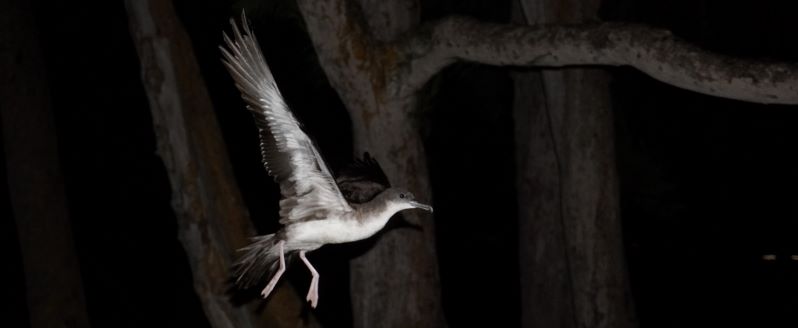
‘Ua’u kani

Pity the wedge-tailed shearwater,
moaning in the dark daily,
rising unfailingly
from beneath the sands
to vanish in shadows
between the pink-orange sky
and the blue-black sea.